
Discovering Nebulae: A Cosmic Journey Between the Birth and Death of Stars

Let's talk about nebulae, because this is a question that comes up very often during my interactions with the public. Through this article, I will try to simplify our understanding of these celestial objects that have fascinated me for so many years.
So, let's embark on a little cosmic journey!
But first, what exactly is a nebula?
Before getting into the heart of the subject, we need to understand the life cycle of stars, because they play a major role in the creation and evolution of nebulae. But there is a little twist...
We often hear that nebulae are simply the result of dying stars, particularly when massive stars explode as supernovae. In reality, things are a little more complex than that.
When a massive star reaches the end of its life and explodes as a supernova, it releases enormous amounts of material into space, including gas and dust. This material gradually disperses into the surrounding space and, under the right conditions, can eventually contribute to the formation of new stars.
However, nebulae can also be regions where interstellar matter accumulates and where new stars are actively being born.
Over millions or even billions of years, material produced by previous generations of stars can be recycled to form new stars and planetary systems. It is a truly remarkable cosmic cycle: stars are born from matter present in space, live out their lives, and eventually return part of that material to their surroundings, allowing new generations of stars to form.
The Universe is, in many ways, a gigantic cosmic recycling system.
The Different Types of Nebulae
Now that you have a better understanding of where nebulae come from, let's take a look at the different types of nebulae we can observe.

1. Emission Nebulae
Emission nebulae are probably some of the most spectacular objects to photograph.
They are mainly made up of gas which, when ionized by the energetic radiation of a nearby star, begins to emit its own light. This is what gives these nebulae their beautiful colors and intricate structures.
In a very simplified way, this phenomenon can be compared to what happens in certain neon signs: the gas becomes energized and emits light at specific wavelengths. A perfect example is the famous Orion Nebula, one of the most photographed deep-sky objects in the night sky.
2. Reflection Nebulae
As their name suggests, reflection nebulae are visible because of the light from a nearby star.
Unlike emission nebulae, they do not necessarily produce their own light. Instead, the light from the nearby star is scattered and reflected by tiny dust particles within the nebula.
This process often gives them a characteristic bluish appearance in photographs, particularly because smaller dust particles scatter certain wavelengths of light more efficiently.
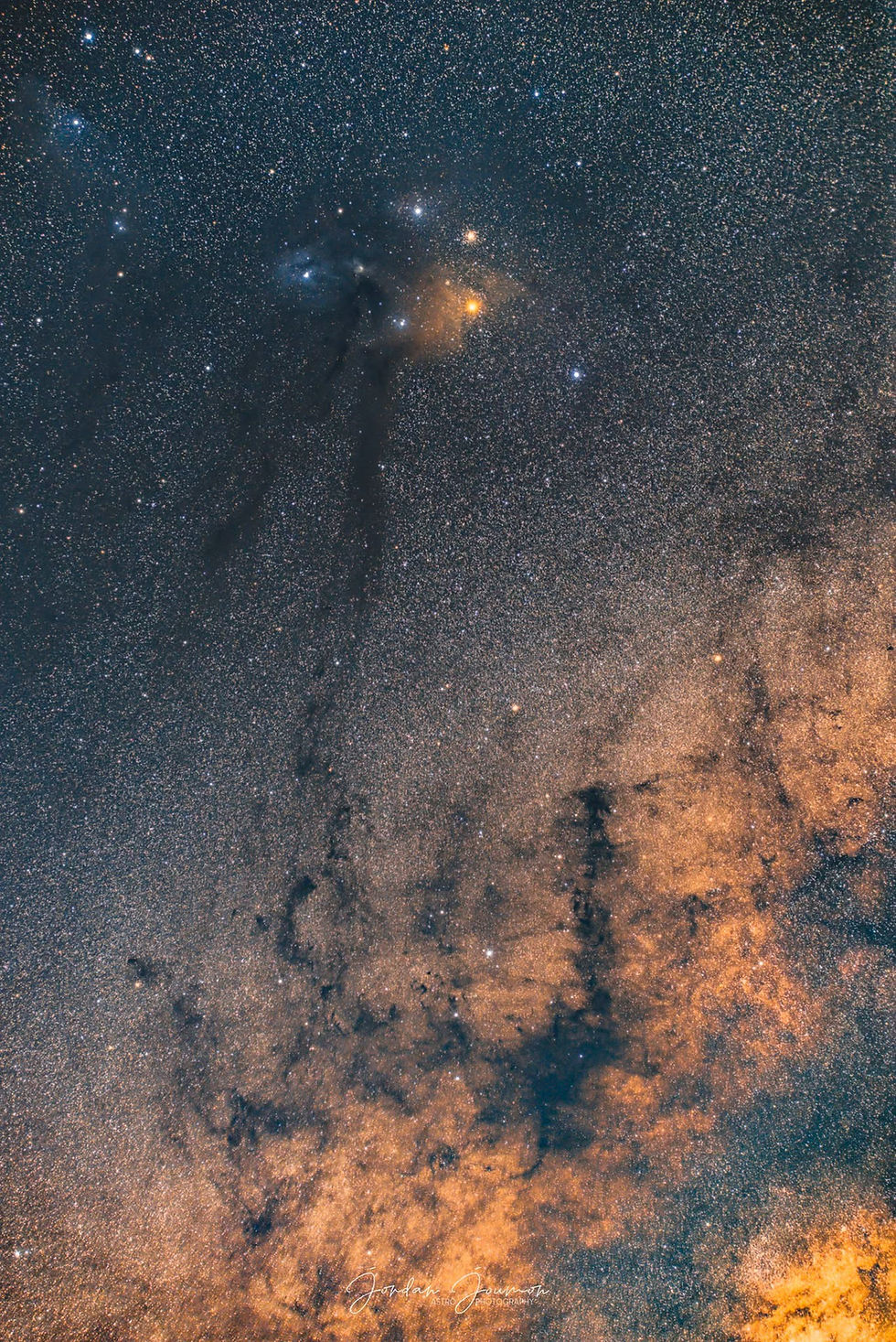
3. Dark Nebulae
On the other side of the spectrum, we have dark nebulae. In this case, the dust does not emit or reflect enough light to be directly visible. Instead, it acts like a giant opaque cloud, blocking the light from stars located behind it.
A very simple example can be seen in photographs of the Milky Way,
where we can observe large dark regions cutting through the bright band of our galaxy.
These dark areas are actually enormous clouds of dust and gas that obscure the light coming from stars located behind them
4. Planetary Nebulae
Finally, we have planetary nebulae.Despite their name, they have absolutely nothing to do with planets! They are generally relatively small and form when a low- or intermediate-mass star reaches the final stages of its life. During this phase, the star gradually expels its outer layers into the surrounding space, creating a beautiful shell of gas around the remaining stellar core.
The name "planetary nebula" simply comes from their appearance. When they were first observed through early telescopes, some of these objects appeared somewhat similar to planets.
Nebulae and Astrophotography
Nebulae are generally among the first objects we learn to photograph when we start exploring deep-sky astrophotography.
There is even an unofficial rule among beginner astrophotographers: start with the Orion Nebula.
And for good reason! It is one of the most famous and easiest nebulae to photograph. It is so bright that it can even be seen with the naked eye under a sufficiently dark sky, making it relatively easy to locate for those who know where to look.
As mentioned earlier, there are different types of nebulae, and while they can all be photographed using either a regular camera or a dedicated astrophotography camera, the approach will vary depending on the nature of the object.
Let's take a simple example.
Emission nebulae are often rich in ionized hydrogen. When this hydrogen is energized by the radiation from nearby stars, it emits light at specific wavelengths, including one known as H-alpha.
This light is not visible to the human eye, but astronomical cameras and specialized filters allow us to capture and isolate it.
By using, for example, an H-alpha filter, astrophotographers can reveal the structure and details of these clouds of gas with much greater contrast than with a standard unfiltered photograph.
However, if you use exactly the same technique to photograph a reflection nebula, you may get very limited results. The light coming from this type of nebula is not primarily emitted at the H-alpha wavelength.
This shows just how important it is to understand the nature of the object you want to photograph before choosing your equipment and imaging technique.
I think we will stop here for the astrophotography section. The goal was simply to show you why understanding the different types of nebulae is so important when beginning your journey into deep-sky astrophotography.
Witnessing the Birth of a New World
To conclude, if you have understood the life cycle of stars and the formation of nebulae, there is one particular stage that I find especially fascinating: the birth of new stars and planetary systems.
One of the most beautiful examples can be found at the heart of the Orion Nebula, where we find the famous Trapezium Cluster, a very young star cluster made up of four particularly bright stars.
These stars were born within this enormous stellar nursery and are still extremely young on a cosmic timescale. Around some young stars, disks of material can also eventually give rise to new planetary systems.
It is fascinating to think that when we point our telescope or camera toward a nebula, we are not simply looking at a beautiful and colorful structure in space.
We may actually be witnessing the birth of another world.
And perhaps this is what fascinates me most about astrophotography: every image tells a story that began millions of years ago, long before we ever looked up at the night sky.
I will now leave you with a collection of some of the nebulae I have had the opportunity to photograph since I began my astrophotography journey. For some of them, I used several of the techniques mentioned above to capture as much detail and information as possible after a long night spent under the stars.
Enjoy this journey through a few of the wonders of our Universe
Veil Nebula astrophotography in Mauritius Nebula photography in Mauritius Orion Nebula Nebula astrophotography in Mauritius Carina Nebula astrophotography in Mauritius Nebula astrophotography in Mauritius horsehead Nebula astrophotography in Mauritius Lagoon Nebula astrophotography in Mauritius Carina Nebula astrophotography in Mauritius Orion Nebula astrophotography in Mauritius running chicken Nebula astrophotography in Mauritius Nebula astrophotography in Mauritius Carina Nebula astrophotography in Mauritius eagle nebula Nebula astrophotography in Mauritius
Jordan JOUMON July 2026


Comments